9/6/22

A report on war losses

 The Polish government a few days ago presented a report on war losses, demanding reparations from Germany. Imagine, that  (among other things), the Polish government wants compensation from the Germans for the Jedwabne pogrom! In the report they also write about Sokolow.


In the report, Mr. Rafal Dmowski of the University of Siedlce (I don’t know who he is) described on two pages the losses of Sokolow during the war. He was wrong basically on all counts.  


He wrote about the "almost complete destruction of the town center" in September 1939. Well, no. Kupientynska Street was destroyed at the beginning of the war, and that's where the photos of burned-out houses come from. The town center - houses, church, town hall - survived, and later the Germans created a ghetto there. Massive destruction occurred in 1944, when the town was bombed by the Russians, but there is not a word about this in the report (why???).


We further read that during the war "a temporary detention center was established on Magistracka Street." Apparently so, but Magistracka Street was named Magistracka in 1944 already after the end of the war. That's because a magistrate was organized in the building of this "prison" - a pre-war Jewish house of prayer - in connection with the bombing of the town hall at the corner of Siedlecka and Dluga Streets by the Russians.


The author goes on to write that the ghetto was established "in the area of Piękna-Prosta-Mala Streets," placing the ghetto completely outside the town at the time. I have the impression that he is guessing because he doesn't know where the ghetto might have been. And he doesn't know because he doesn't know the sources.


Then we have the information that "before the outbreak of war, there were about 4,000 Jews living in the town." Wrong again! According to statistics from the Central Statistical Office, in 1921 Sokolow had a population of 8055, of which 4430 people declared themselves to be of the Jewish faith. In 1931, out of a total population of 9918, 5027 people declared being Jewish.


In the next sentence we learn that "the Germans proceeded to liquidate the ghetto on September 30, 1942." Another untruth. It was September 22, 1942, a date I learned with certainty, and since 2011 I have been organizing commemorations on that day, as Mr. Dmowski studying in Siedlce should have known. Just as he should have read our translations from Yiddish to Polish of the memorial books - available for free on the internet!


So dear friends this whole report has nothing to do with history, but rather with propaganda.


9/2/22

Pinchas Ogrodnik

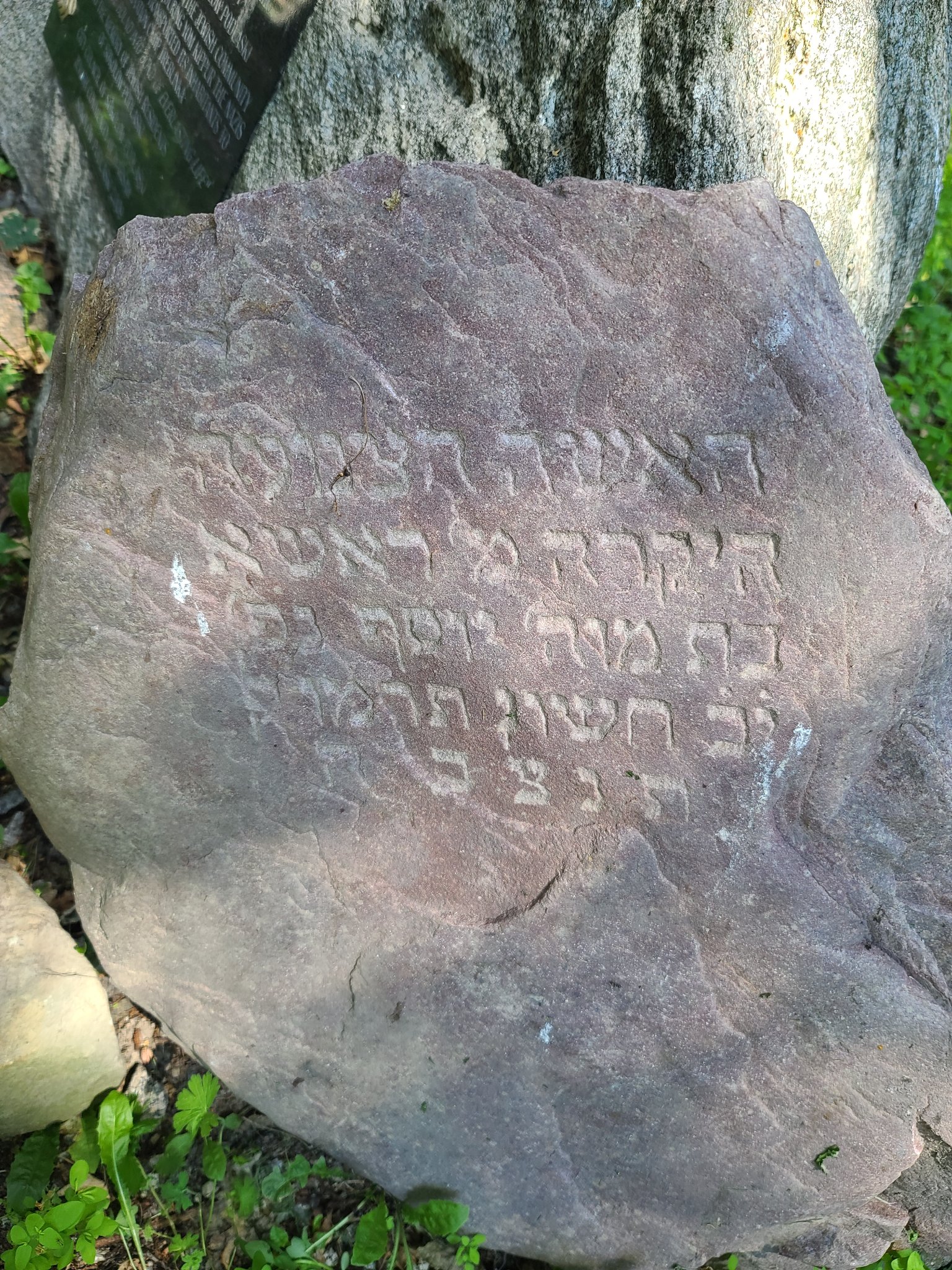
Today at the Jewish cemetery in Sterdyn I found this tombstone. It is written in Yiddish, which is unusuall. The reason for that may be that the person here was probably a leftist. I will try to find out more about him but maybe any of you have more information?


The tombstone reads:


Here lies the deceased companion OGRODNIK Pinchas. He died after a long time in prison in Siedlce. He was born on August 1, 1902, died on April 30, 1926.


7/25/22

Rasza Sztutman

 Rasia/Rasza Sztutman passed away in November 1883. Her father was Josef/Josel. Thanks to collective work we were able to connect her tombstone with her death certificate from the Siedlce Archive.

Thank you!


7/23/22

Traces of the past

 There used to be a mikveh (religious bath) in this place. I heard rumors that the Germans killed Jewish policemen in this place during the war, but I have not found confirmation of this information in the archives. Today a new apartment block is being built here. 

Fewer and fewer traces of Sokołów's Jewish past.


7/20/22

Moszko-Symcha Sztutman

 Yesterday I was looking for the death certificate of Rasza - Josef's daughter, who died in 1885. It was her matzeva that someone had brought to the Jewish cemetery in Sokołów, and I wanted to find out what her last name was.

I didn't find her death certificate. But I found such a document. In 1947, Moszko-Symcha Sztutman changed his name to Szymon Sztucki. Moszko-Symcha was born on June 15, 1885. His parents were Abram-Lejb and Jenta nee Wiksman. In Sokołów, Moszko-Symcha lived at 18 Rogowska St.

I guess he wanted a more "Polish" surname after the war, but the name Szymon at the time was typically Jewish (today you will find a lot of non-Jewish boys with that name).

Do any of you know the background of this story?


7/19/22

Another pieces of the tombstones

 A few months ago, I appealed to residents of Sokołów to bring pieces of matzevot they have to the Jewish cemetery. And they did it! 

Another pieces of the tombstones are where they should be. Thank you to those who brought the matzevot! Thank you Joanna for the photos!

If you have this kind of stones at your home - bring them here. Thank you very much!


7/17/22

The board of the Jewish community in Sokolow, Kosow and Sterdyn in 1918

During World War I, the Germans were also stationed in Sokolow. Their rule of occupation was associated with high taxes and a lack of food among the population (food had to be donated to the army). On the other hand, the Germans allowed the founding of both Jewish and non-Jewish social organizations for the first time. In 1918, they organized elections to the board of the Jewish community in Sokolow, Kosow and Sterdyn.


In Sokolow, the following were elected to the board: Mozes Borychowski, Srul Henoch Schwarzwort, Mozes Lustigman, Hersz Towia Ber and their deputies: Alter Kafowy, Jakow Edelsztein, Rochmiel Rybak, Jakow Kiwajko.


In Kosow, the following were elected to the board: Sindel Lehrmann, Abram Zelaniec, Abram Mozesohn, Mozes Flamm and their deputies: Szlama Weisberg, Majer Rowiński, Izak Brzoza and Józef Kiczkowski.


In Sterdyn the following were elected to the board: Abram Wajngart, Chaskiel Srence, Berek Kotlarski, Judko Ceranko and their deputies: Abram Bromberg, Szlama Goldberg, Chune Radzyński, Icek Styczyński.